
Project Overview
Soft soil foundations present one of the most persistent and costly challenges in road construction worldwide. Weak subgrades—characterized by low bearing capacity, high compressibility, and poor drainage—can lead to excessive settlement, rutting, and premature pavement failure if not properly addressed. Traditional solutions often require excavation and replacement of 500 to 1,000 mm of soft subgrade with granular fill, a material-intensive and time-consuming approach.
This case study examines the application of biaxial geogrid in reinforcing road subgrades over soft soil conditions. Drawing on documented projects from various regions—including the historic Sungei Way trial in Malaysia (1984), the He-Yun Expressway in China, and a coastal expressway project in Zhejiang Province—it demonstrates how biaxial geogrid reinforcement provides a cost-effective, durable, and sustainable alternative to conventional deep excavation methods.
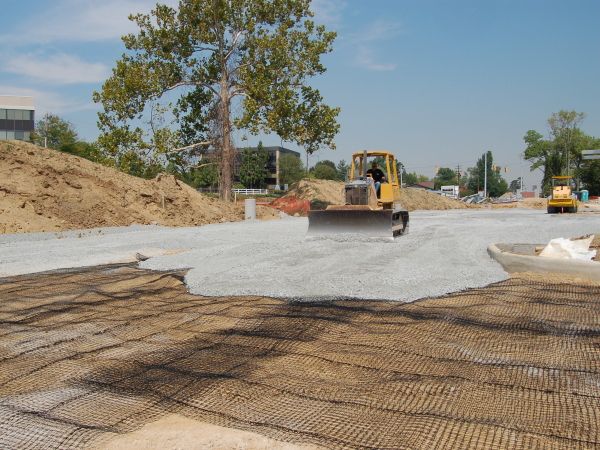
The solution applies to paved and unpaved roads, highway embankments, access roads, and airport pavements—any application where soft subgrade conditions threaten long-term structural performance.
Engineering Challenge
Soft soil foundations create a cascade of engineering problems that undermine road performance:
1. Excessive Settlement
Soft clays, silts, and organic soils exhibit high compressibility under load. When a road embankment is constructed over such soils, primary and secondary consolidation settlements can continue for years or even decades, leading to uneven road surfaces, pavement cracking, and costly maintenance interventions.
2. Differential Settlement
Perhaps more damaging than total settlement is differential settlement—the uneven displacement between adjacent sections of a road. This is particularly acute at the transition between new and existing embankments in road widening projects, and at bridge approaches where the “bump at the end of the bridge” phenomenon (commonly known as “bridge bump”) creates safety hazards and ride quality issues.
3. Low Bearing Capacity
Weak subgrades with California Bearing Ratio (CBR) values as low as 2.5% cannot adequately support traffic loads without excessive deformation. This leads to rutting in unpaved roads and structural failure in pavements.
4. Lateral Displacement
Under embankment loading, soft soils can squeeze laterally, causing slope instability and undermining adjacent structures. The lateral displacement of soft ground can be as damaging to project integrity as vertical settlement.
5. Construction and Cost Constraints
Traditional solutions—excavating and replacing soft soil with imported granular fill—are expensive, time-consuming, and environmentally impactful. Hauling vast quantities of aggregate, disposing of excavated soft soil, and managing construction schedules in poor ground conditions add significant cost and carbon emissions to projects.
The Core Challenge: How can engineers build durable roads over soft ground while reducing material consumption, construction time, and long-term maintenance costs?
Our Solution: Biaxial Geogrid Reinforcement
Biaxial geogrids provide an engineered solution to these challenges through a mechanically stabilized layer (MSL) that transforms weak subgrades into load-bearing foundations.
How It Works
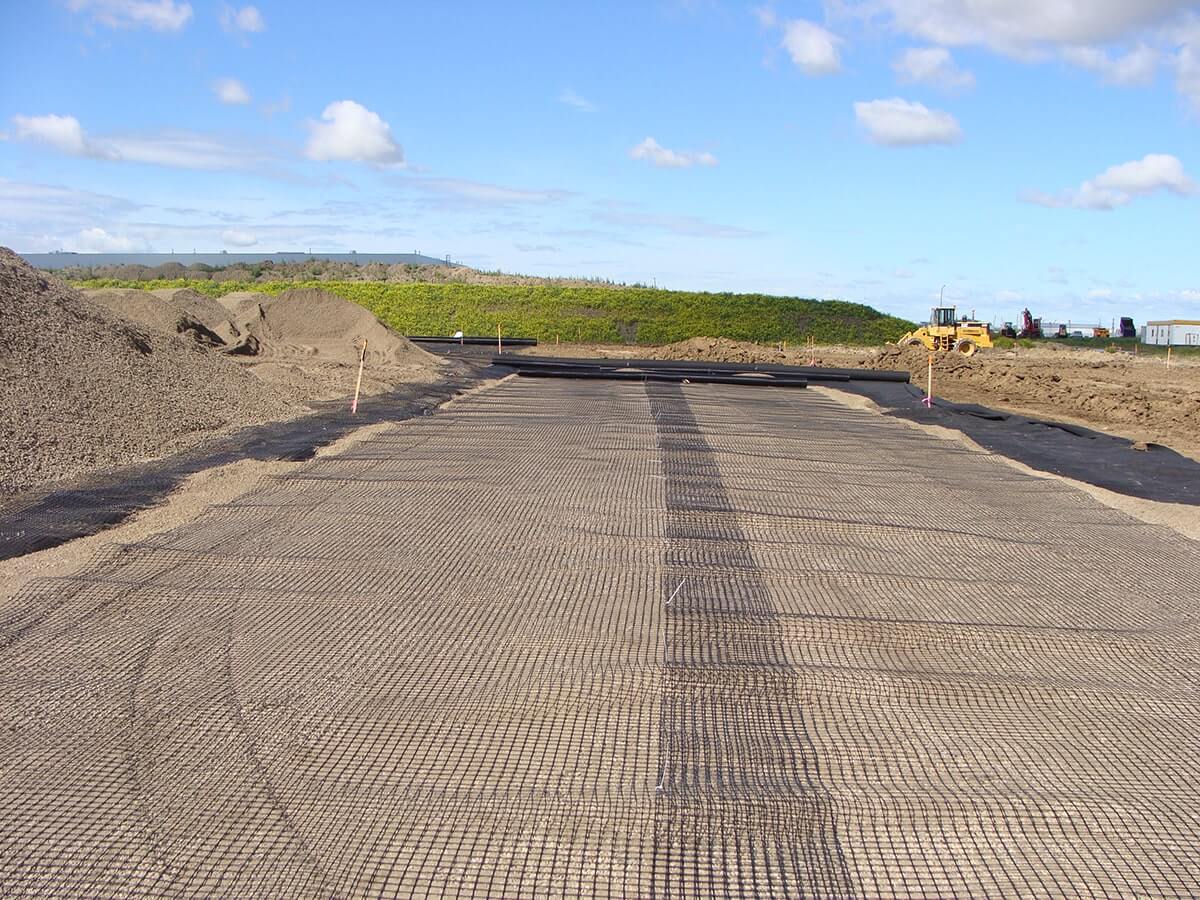
The biaxial geogrid is placed at the interface between the soft subgrade and the overlying granular fill (base or subbase course). Through three primary mechanisms, it improves road performance:
1. Confinement
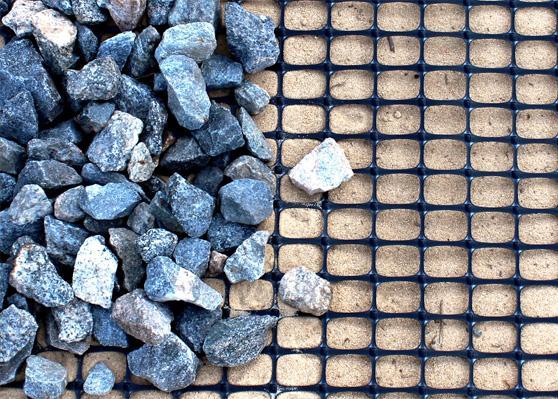
2. Interlock
3. Tension Membrane Effect
Recommended Specifications
| Parameter | Recommendation | Justification |
|---|---|---|
| Material | Polypropylene (PP) biaxial geogrid | High strength, chemical resistance, durability |
| Tensile Strength | 30–50 kN/m (standard), up to 120 kN/m (heavy-duty) | Match traffic loading and subgrade conditions |
| Aperture Size | 20–50 mm square | Optimal aggregate interlock |
| Placement | At subgrade/base interface or within base course | Maximum reinforcement efficiency |
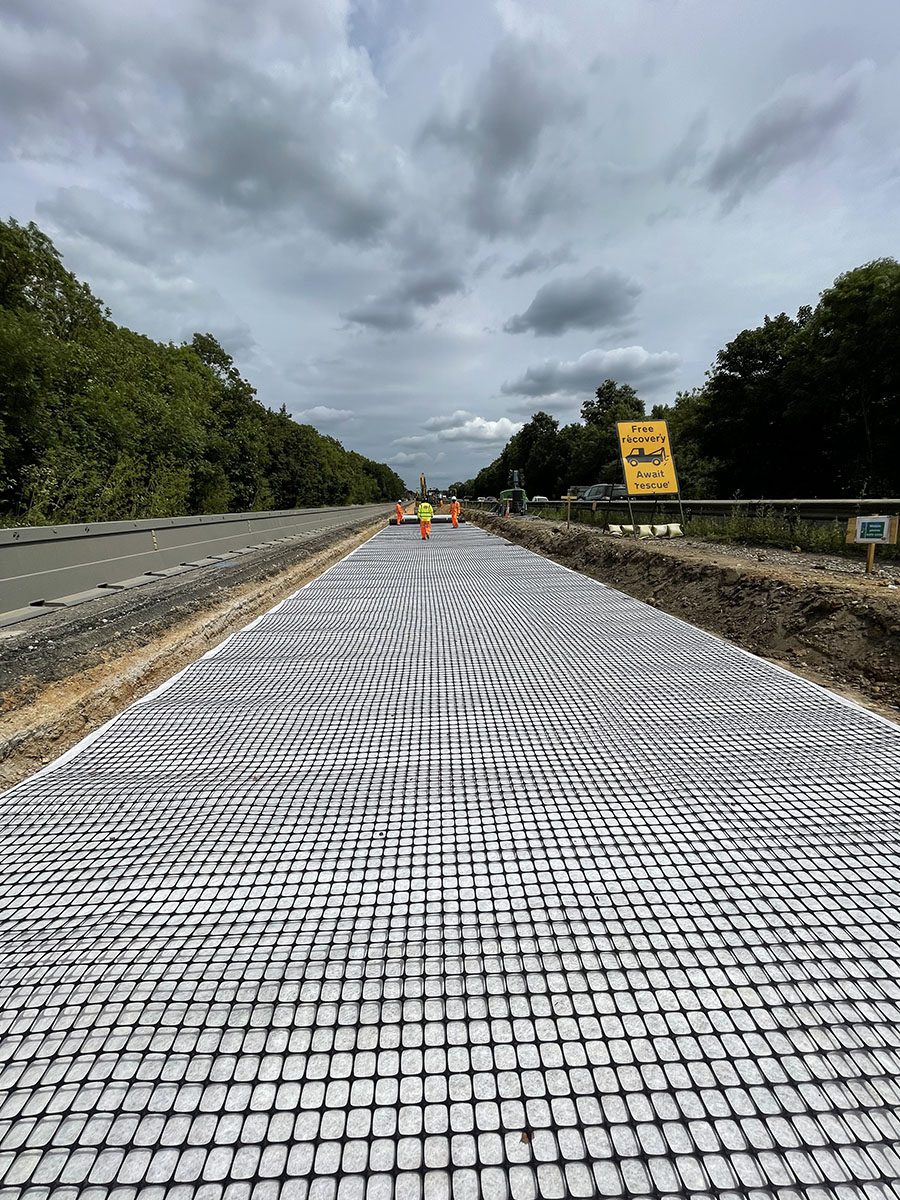
| Coverage | Full-width, with minimum 0.5 m overlap | Continuous reinforcement |
Installation Best Practices
-
Subgrade Preparation: The soft subgrade is leveled and compacted to provide a uniform surface. If subgrade is extremely soft, a geotextile separator may be placed beneath the geogrid.
-
Geogrid Placement: The geogrid is rolled out over the prepared subgrade in the direction of construction. Adjacent rolls are overlapped (typically 0.5–1.0 m) and pinned or stapled to maintain position.
-
Granular Fill Placement: The first lift of granular fill (typically 150–300 mm) is placed over the geogrid. Care must be taken to avoid direct equipment traffic on the exposed geogrid.
-
Compaction: The granular layer is compacted to specification. The geogrid becomes an integral part of the stabilized layer.
-
Subsequent Layers: Additional lifts of fill or pavement layers are constructed as per design.
Results & Benefits
Performance Outcomes from Documented Projects
1. Substantial Bearing Capacity Improvement
Plate load tests on reinforced unpaved road sections over soft subgrade showed that biaxial geogrid reinforcement increased bearing capacity by approximately 34.6% when placed within the top one-third of the subgrade layer. This improvement enables roads to carry heavier traffic loads without structural failure.
2. Significant Settlement Reduction
A coastal expressway project in Zhejiang Province, China, employed a combination of “biaxial geogrid + plastic drainage board at 0.8 m spacing.” Field monitoring data showed:
-
35.8% reduction in cumulative settlement at 6 months post-construction compared to conventional methods
-
Pavement deflection values stabilized at 0.32 mm (well within the 0.5 mm specification limit)
Another study on a coastal expressway widening project showed that geogrid reinforcement reduced the risk of differential settlement between new and old embankments while significantly improving overall stability.
3. Equivalent Performance with Reduced Section Thickness
Research has demonstrated that a 300 mm granular subbase reinforced with biaxial geogrid can provide equivalent performance to a 450–500 mm unreinforced subbase—representing a material saving of 33–40%.
This thickness reduction translates directly into:
-
Less aggregate extraction and transport
-
Reduced excavation and disposal of unsuitable material
-
Shorter construction timelines
-
Lower project costs
4. Improved Long-Term Durability
The mechanically stabilized layer (MSL) created by biaxial geogrid reinforcement protects the subgrade from excessive damage, reduces maintenance requirements, and enables uninterrupted traffic operations. In one documented access road project in Malaysia, the geogrid-reinforced section prevented the recurring road failures that had previously plagued the estate’s truck access routes.
5. Structural Benefits in Highway Applications
On the He-Yun Expressway in China, bidirectional double-layer geogrid was applied to address differential settlement at earthwork junctions. Analysis confirmed the geogrid’s unique reinforcement properties in controlling settlement and distributing loads.
6. Tensile Deformation Characteristics
Field tests on the Rongwu Expressway in China’s Xiong’an New Area revealed that biaxial geogrid exhibits greater tensile deformation between two pile supports than between four, with transverse tensile deformation exceeding longitudinal deformation. This understanding enables more precise design of geogrid reinforcement in pile-supported embankments.
Cost Efficiency
| Area of Savings | Typical Impact |
|---|---|
| Aggregate Volume | 33–40% reduction in granular fill thickness |
| Excavation/Disposal | Reduced volume of unsuitable material removal |
| Construction Time | Faster installation compared to deep excavation |
| Maintenance | Reduced frequency and cost of road repairs |
| Lifecycle Carbon | Lower emissions from material transport and compaction |
A documented project using geogrid reinforcement saved an estimated £5,000 per kilometer of road (approximately 20–25% of construction cost), with a total project saving of £200,000. Other projects have reported construction time reductions of up to 35% and cost savings of 20% or more.
Real-World Applications
Malaysia’s Pioneering Application (1984–1987)
-
Interlock between geogrid and granular material with minimal deformation
-
Minimized tensile strains and deformations in subgrade
-
Confinement of granular materials, minimizing lateral displacement
Zhejiang Coastal Expressway, China
Riverview Estate Access Road, Malaysia (2024)
Conclusion
Biaxial geogrid reinforcement has proven to be a highly effective solution for road construction over soft soil foundations. The documented evidence from multiple projects across different regions and conditions consistently demonstrates:
-
Bearing capacity improvements of 30–35% or more
-
Settlement reductions of up to 35% compared to conventional methods
-
Material savings of 33–40% through reduced granular fill requirements
-
Cost savings of 20–25% or more on construction
-
Extended service life with reduced maintenance requirements
For engineers and project owners facing the challenges of soft ground construction, biaxial geogrids offer a proven, cost-effective, and sustainable solution that transforms problematic subgrades into stable, durable foundations.
For more information on our biaxial geogrid product range or technical support for your specific project, please visit wordmaterial.com or contact our engineering team.